

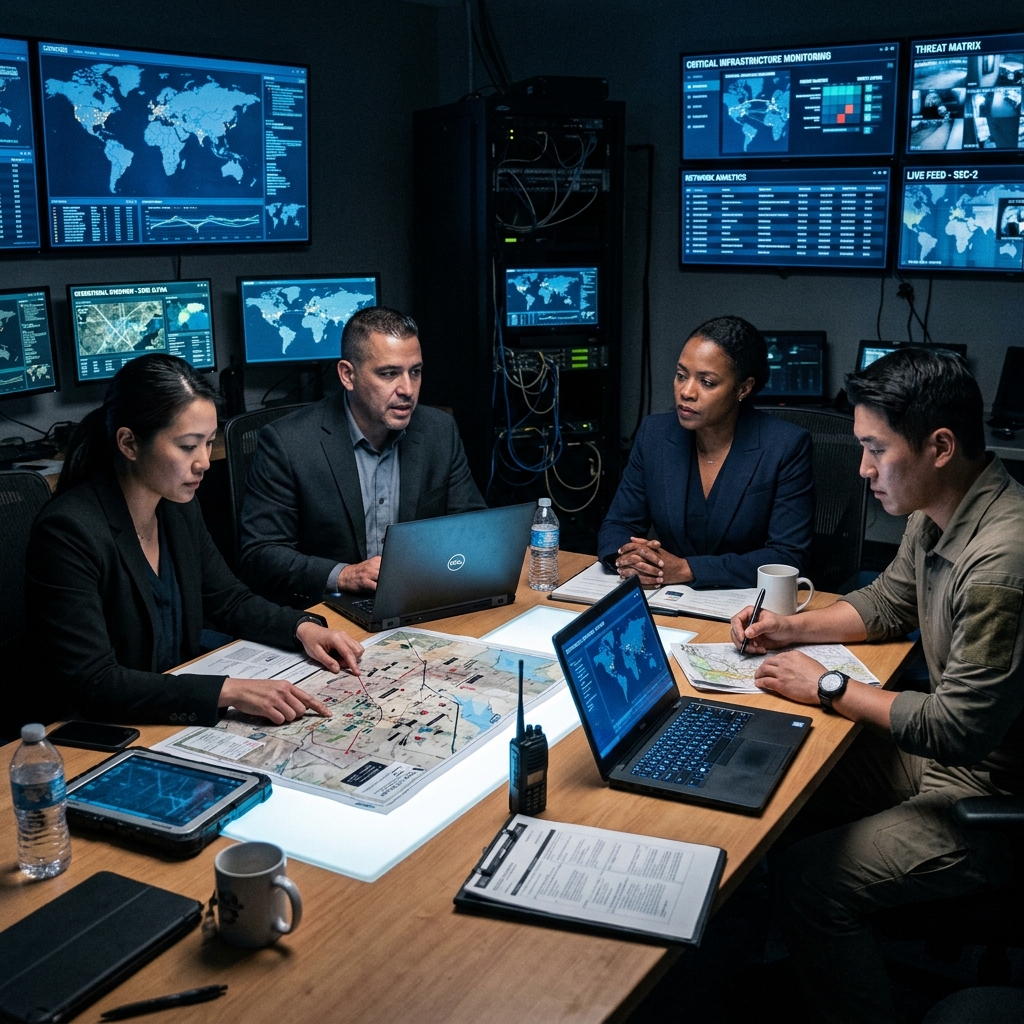
In an era of escalating threats to corporate leaders, high-net-worth individuals and public figures, the traditional security model — reactive guards posted at doors — is no longer sufficient. Protective intelligence represents a fundamental evolution in how we approach personal and organisational security: a proactive, analytically driven discipline that identifies and neutralises threats before they materialise.
Defining Protective Intelligence
Protective intelligence is the systematic collection, analysis and dissemination of information concerning threats to an individual, organisation or asset. Unlike conventional security measures that respond to incidents after they occur, protective intelligence operates upstream — monitoring the threat landscape, identifying concerning behaviours and patterns, and enabling decision-makers to take pre-emptive action.
The discipline draws from multiple intelligence traditions — military intelligence, law enforcement threat assessment and private sector security analysis — combining them into a cohesive framework tailored to the protection of specific principals. At its core, protective intelligence answers a deceptively simple question: Who poses a credible threat, and what can we do about it before harm occurs?
How It Differs from Traditional Security
Traditional executive protection focuses on physical presence — close protection officers, secure transportation, hardened residential security. These remain essential elements of any comprehensive protection programme, but they are inherently reactive. A close protection officer intervenes when a threat presents itself physically. Protective intelligence aims to ensure that moment never arrives.
The distinction is analogous to the difference between treating a disease and preventing it. Traditional security treats the symptom; protective intelligence addresses the root cause. A well-resourced protective intelligence programme will identify a fixated individual's escalating behaviour patterns weeks or months before they attempt to approach a principal — providing the opportunity for intervention through legal channels, operational countermeasures or enhanced physical security postures.
Key Components of Protective Intelligence
Threat Assessment
Rigorous threat assessment forms the foundation of any protective intelligence programme. This involves evaluating individuals or groups who may pose a risk to the principal, examining their capability, intent and opportunity to cause harm. Modern threat assessment methodologies draw on behavioural science research, analysing warning behaviours such as fixation, identification with previous attackers, novel aggression and energy burst patterns that indicate movement along the pathway to violence.
Vulnerability Analysis
Understanding the principal's exposure points is equally critical. Vulnerability analysis maps daily routines, travel patterns, public appearances and digital presence to identify where and when the principal is most exposed to potential threats. This assessment extends beyond physical vulnerability to encompass digital attack surfaces, reputational risks and operational security gaps that adversaries might exploit.
Open-Source Intelligence (OSINT) and Digital Monitoring
The modern threat landscape is increasingly digital. Social media monitoring, dark web scanning, data breach analysis and digital footprint assessments form a critical component of protective intelligence. An individual's online presence — corporate filings, property records, social media posts, family members' digital activities — creates an information ecosystem that skilled adversaries can mine for operational intelligence. A robust protective intelligence programme monitors these channels continuously, identifying when the principal's personal information surfaces in contexts that indicate hostile interest.
Human Intelligence Networks
Technology alone cannot replace the value of human intelligence. Maintaining relationships with law enforcement agencies, private intelligence networks and local sources in key operating environments provides access to information that no automated system can capture. The ability to contextualise raw intelligence through human judgement and operational experience remains irreplaceable.
Why Protective Intelligence Matters
The threat landscape facing executives and high-net-worth individuals has evolved dramatically. Domestic extremism, corporate espionage, targeted cyber-attacks, stalking and harassment, activist targeting and kidnap-for-ransom threats are no longer exceptional events — they are operational realities that demand sophisticated, intelligence-led responses.
High-profile data breaches regularly expose personal information that adversaries can weaponise. Social media creates unprecedented visibility into individuals' lives and movements. Geopolitical instability in key business regions introduces risks that shift rapidly and unpredictably. In this environment, the organisations and individuals who invest in protective intelligence gain a decisive advantage: the ability to anticipate threats rather than merely respond to them.
Granite Intel & Protection's Approach
At Granite Intel & Protection, protective intelligence is not an add-on service — it is the intellectual foundation upon which all our protection programmes are built. Every close protection deployment, every travel security plan, every residential security assessment begins with a thorough intelligence picture that informs proportionate, effective protective measures.
Our protective intelligence team comprises former military intelligence operators, law enforcement intelligence analysts and cyber-intelligence specialists. They maintain continuous monitoring on behalf of our clients, producing regular intelligence summaries, threat updates and ad-hoc alerts that enable informed decision-making. When the threat picture changes, our response adapts in real time — escalating or de-escalating protective measures based on actionable intelligence rather than assumption or anxiety.
This intelligence-led approach delivers measurable outcomes: threats identified earlier, resources deployed more efficiently, and principals protected with minimal disruption to their professional and personal lives. It is the difference between security that reacts and security that anticipates.